

City-Level Rank Tracking in India: Why National Rankings Mislead You
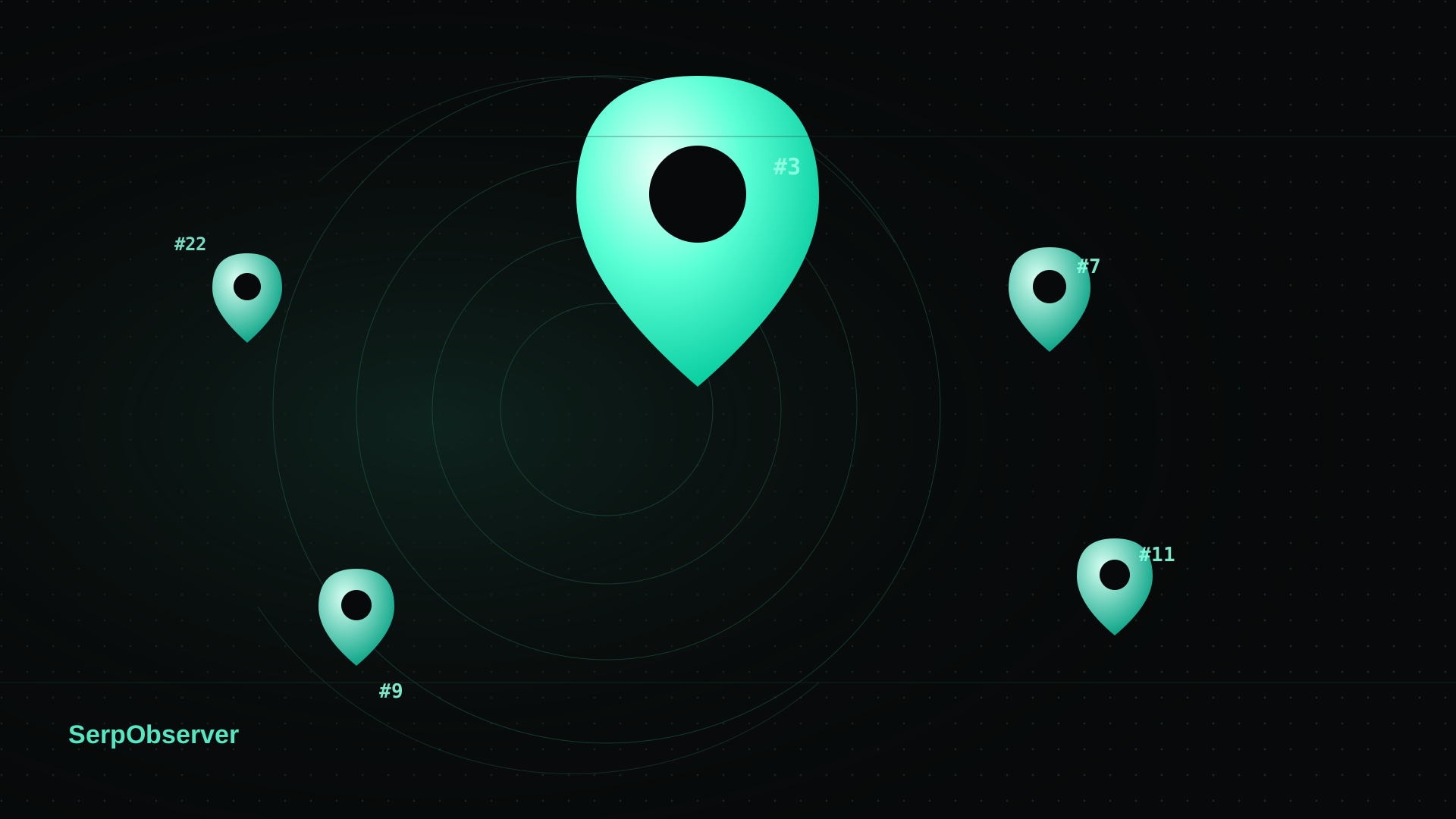
National keyword rankings give Indian SEOs a false picture. The same keyword can rank #3 in Delhi and #11 in Chennai. Here's why city-level tracking is the only honest way to measure Google performance in India.
Quick Answer
City-level rank tracking in India means monitoring your Google keyword positions separately for each city — Delhi, Mumbai, Bangalore, Chennai, Hyderabad, etc. — rather than a single national average. It matters because India's SERPs are hyper-localised: the same keyword can rank #1 in Pune and #9 in Lucknow simultaneously. National rankings hide this gap and lead to wrong SEO decisions.
The myth of "ranking in India"
When most rank trackers report your position for a keyword in India, what they're actually doing is checking Google.co.in from a neutral geographic point — often a server in the US or Singapore with gl=in appended to the query.
That's not how your customers search.
Your customer in Bhopal is searching from Bhopal. Your customer in Kochi is searching from Kochi. And Google — especially for anything even mildly location-sensitive — is giving them different results. Sometimes very different results.
The national number you've been reporting? It's a weighted approximation that accurately represents almost nobody.
How different are rankings actually, city to city?
Take the keyword "accounting software for small business" — not an inherently local query. Yet in our tracking data, the same domain routinely shows:
Position 3 in Delhi NCR
Position 7 in Bangalore
Position 11 in Chennai
Position 5 in Hyderabad
Position 9 in Kolkata
Same website, same page, same keyword — just checked from different cities. The delta between best and worst is 8 positions. That's the difference between page one and page two.
Now imagine how extreme this gets for genuinely local queries: "best dentist near me," "car service centre," "real estate agent in [area]." Those gaps aren't 8 positions — they're pages apart.
Why does this happen?
Google's ranking algorithm uses location as one of its strongest signals. When someone searches, Google knows:
Where the searcher is — down to the city, neighbourhood, and sometimes the block
What local businesses are relevant — from Google Business Profile signals
Which pages have earned local authority — through local backlinks, locally-relevant content, and NAP consistency on Indian directories (JustDial, Sulekha, IndiaMart)
What language and script the searcher expects — Hindi results for a Hindi search, even if the keyword is ambiguous
All of these signals combine differently in each city. A business with strong Bangalore-area backlinks might dominate that market but barely appear in Pune, even if their product or service is equally good in both places.
See our complete guide to tracking Google rankings in India →
The problem with global rank trackers
Ahrefs tracks your keyword ranking in India. SEMrush does too. They're not lying — they are checking Google.co.in. But they check it the same way every time, from the same location approximation. They give you one number per keyword per country.
For India, one number is not enough.
This isn't a criticism of those tools — they're excellent for backlink research, site audits, and global campaign management. But their rank tracking was designed for markets where one country roughly equals one search context. India is not that market.
India is 1.4 billion people, 22 official languages, 28 states with distinct economies, and hyper-local search intent that varies at the pincode level. A single gl=in check cannot represent that.
See how SerpObserver compares to Ahrefs for Indian agencies →
What city-level tracking actually looks like
When you set up a keyword in SerpObserver with city-level tracking, you're creating separate tracking instances for each location:
best accountant | Desktop | Delhi NCR | Google.co.inbest accountant | Desktop | Mumbai | Google.co.inbest accountant | Desktop | Hyderabad | Google.co.inbest accountant | Mobile | Delhi NCR | Google.co.in
Each one is tracked independently, updated daily, and stored with its own rank history. This is not exotic. This is the minimum bar for honest SEO reporting in India.
And pincode-level goes even further
"Mumbai" covers Bandra, Andheri, Dadar, Worli, and Navi Mumbai. A clinic in Bandra West is not competing for the same patients as a clinic in Kharghar. Their Google Maps rankings are completely different.
SerpObserver supports tracking by pincode. You can track best dermatologist | 400050 (Bandra) separately from best dermatologist | 400706 (Kharghar). When you're reporting to a client who serves a specific locality, you stop giving them city averages and start giving them the number that actually describes their business.
The reporting problem this creates for agencies
If you've been reporting national rankings to clients, you've probably been over-reporting performance in some cities and under-reporting it in others.
A client in Coimbatore who paid for "SEO services" is not impressed that they rank nationally when their actual customers in Coimbatore can't find them. And if they search themselves (which they will), they're going to call you confused.
City-level tracking protects the relationship between you and your client. When a ranking drop happens — and it always does — you know where it happened and why.
The national ranking number still has its place
National-level ranking data isn't worthless. It's useful for tracking genuinely non-local keywords — software tools, SaaS products, informational content without local intent. But if you're an agency managing clients who serve specific geographies, national rankings are giving you a false sense of how visible you actually are.
See the best rank tracking tools for Indian SEO in 2026 →
How to set up city-level tracking in SerpObserver
When you add a keyword to a project, choose:
The keyword — in any language or script, including Hindi, Tamil, Telugu, Bengali
The search engine — Google.co.in (default), Bing, or YouTube
The device — desktop or mobile (tracked separately, same keyword slot)
The location — choose from 50+ Indian cities, or enter any pincode
Quick setup checklist
Which cities matter? List the cities where your client's customers actually are. Don't track 20 cities if the client only sells in 3.
Mobile or desktop — or both? For local searches, mobile matters more. Prioritise mobile for local businesses.
Which keyword variations matter by city? A "restaurant" search in Chennai often includes Tamil modifiers. Plan your keyword list per city.
How will you report? SerpObserver supports rank-drop alerts that email you automatically when a keyword drops more than 5 positions overnight.
The bottom line
National rankings are easy to generate and easy to present. They're also easy to misinterpret.
India's search landscape doesn't compress into a single number per keyword. City-level tracking isn't a premium feature for large agencies. It's the baseline for doing honest SEO work in India.
Frequently Asked Questions
What is city-level rank tracking in India?
City-level rank tracking means checking your keyword positions on Google separately for each Indian city, rather than a single national result. Because Google localises search results based on the searcher's location, your rank in Delhi is often different from your rank in Mumbai or Chennai.
Why do rankings differ between Indian cities?
Google uses location as a strong ranking signal. It factors in proximity to the searcher, local backlinks, Google Business Profile strength in that city, and local content relevance. A site that has built authority in Bangalore may not have the same signals in Jaipur.
Which cities should I track rankings for?
Start with the cities where your customers are located. For most businesses: Delhi NCR, Mumbai, Bangalore, Chennai, Hyderabad, Kolkata, Pune, and Ahmedabad. For hyperlocal businesses, consider pincode-level tracking.
Can I track city-level rankings for free?
SerpObserver's free plan tracks 10 keywords at the national India level. City-level and pincode-level tracking starts with the Pro plan at ₹1,999/month. Every account gets a 14-day free trial of Pro — no credit card needed.
Does SEMrush or Ahrefs do city-level India tracking?
Not in the same way. Both tools track at the country level (gl=in) but don't support tracking the same keyword across Delhi, Mumbai, Chennai, and Hyderabad as a standard India agency workflow. SerpObserver is built specifically for this use case.
What is pincode-level tracking and when do I need it?
Pincode-level tracking checks your rankings from a specific Indian pincode — like 400001 (Mumbai Fort) or 110001 (Delhi Connaught Place). It's essential for hyperlocal businesses — clinics, restaurants, real estate — where even two localities in the same city show completely different results.
Start tracking the cities that matter
10 keywords. 50+ Indian cities. Daily updates. No credit card.
Start Free (14-Day Pro Trial)See Plans & Pricing
Related: How to Track Your Google Rankings in India · Track Rankings by City: Delhi vs Mumbai vs Bengaluru · SerpObserver vs Ahrefs for Indian SEO
Track your rankings with SerpObserver
City-level rank tracking built for Indian SEO. Free for up to 10 keywords.
Start for Free