

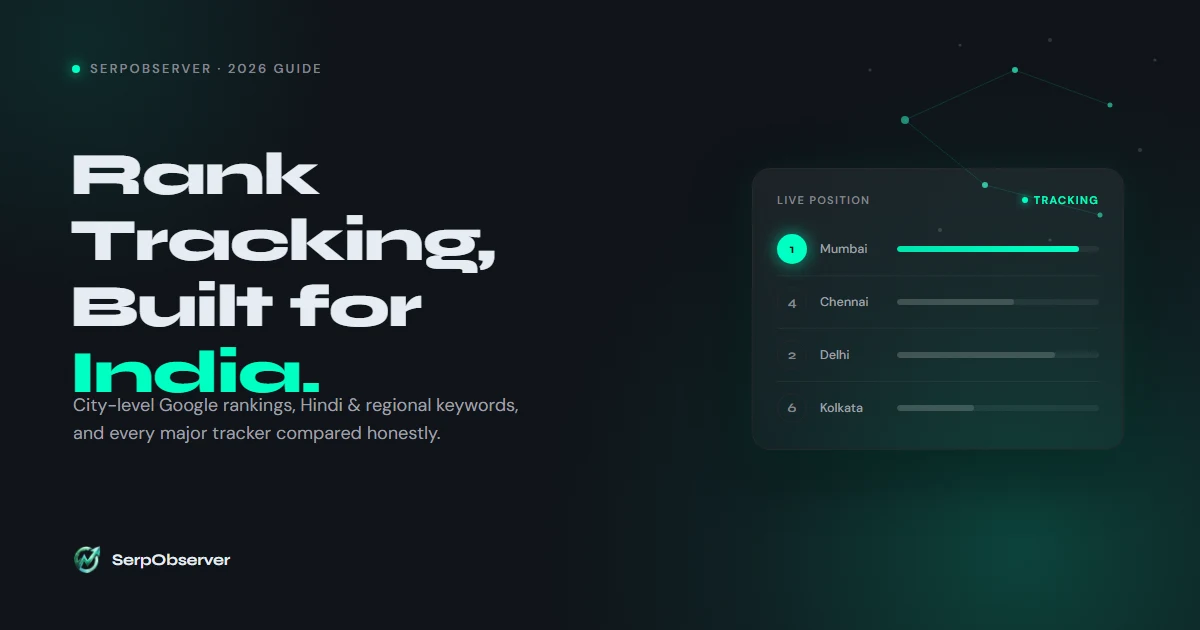
Best Rank Tracking Tools for Indian SEO in 2026: A Practitioner’s Guide
A practitioner's comparison of rank tracking tools for Indian SEO — what actually matters when you're tracking Google.co.in rankings across Indian cities, in English and regional languages.
If you just searched "best rank tracker India," there's a good chance you've already tried one of the big global tools and hit the same wall: it tells you where you rank in general, not where you rank in Mumbai, or Chennai, or wherever your actual customers are searching from. For most Indian businesses and agencies, that gap is the whole ballgame.
One disclosure up front: we build SerpObserver, a rank tracker made specifically for the Indian market, so read our opinions here with that in mind. But everything below is about what each tool actually does, not what we wish it did — and a couple of these (Google Search Console especially) are worth using even if you never touch our product.
Quick answer: If you need city-level accuracy for Indian search results — Mumbai vs. Delhi vs. Bengaluru, in English or a regional language — you need a tool built around Google.co.in and Indian locations specifically. General-purpose global suites like SEMrush and Ahrefs are genuinely good at backlinks and content research, but they weren't built to split a ranking by Indian city. That's the gap this whole list is organized around.
How We Judged These Tools
We didn't rank these on feature count. We ranked them on three things that actually change whether the data is useful for an Indian business:
- Location accuracy. Does it check Google.co.in from a real Indian city, or hand you one blended, national-average number?
- Language coverage. Can it track a Hindi, Tamil, Telugu, or Bengali keyword, or is it English-only?
- Price-to-value in India. Is it priced and billed for the Indian market, or is it a USD tool with a rupee conversion bolted on?
None of the global tools fail on all three. But most fail on at least one, and it's usually the first.
The Short List: Rank Trackers Worth Using in India (2026)
Six options, ranked for the Indian market specifically — not a generic "best SEO tools anywhere" list.
1. SerpObserver — Best for City-Level Accuracy in India
SerpObserver checks Google.co.in rankings by Indian city — Mumbai, Delhi NCR, Bengaluru, Hyderabad, Chennai, Kolkata, and dozens more — rather than one national number. Every plan tracks in Hindi and regional languages alongside English, which matters for a Chennai search in Tamil or a Kolkata search in Bengali. Pricing is in INR, billed the way an Indian freelancer or agency actually budgets, and every new account gets a genuine 14-day free trial of the Pro plan with no card required.
It's the newest tool on this list, so it doesn't have Ahrefs' backlink index or SEMrush's PPC research tools. If you need those, you'll want a second tool alongside it — see the comparison table below.
2. Google Search Console — Best Free Starting Point
Every Indian site owner should have this connected regardless of what else they use. It's free, it's from Google directly, and it shows the average position your pages actually earned in search results. The catch: the data is aggregated, sampled, and delayed by a few days, with no way to split it by city or see what a competitor is doing. Think of it as ground truth you check against, not a daily tracking tool. Our guide to connecting Search Console covers how to use it alongside a dedicated tracker instead of picking one or the other.
3. SEMrush — Best All-in-One Suite
SEMrush is a genuinely broad platform — keyword research, backlink audits, content tools, and PPC data live in one dashboard, and rank tracking is one module among many. That breadth is the appeal if you need all of it. It's priced and billed in USD as a global product, and its rank tracking treats India as one market rather than a set of cities, so you get a national number, not a Mumbai number and a Chennai number.
4. Ahrefs — Best for Backlink-Heavy Research
Ahrefs is respected industry-wide for one thing in particular: the depth of its backlink index. If link-building research is a core part of your work, it's hard to beat. Its rank tracking module works fine for a national view, but like SEMrush, it's a USD-priced global tool without India-specific city tracking or regional-language keyword support built in.
5. SE Ranking — Best Mid-Market Global Tracker
SE Ranking sits between the big all-in-one suites and a dedicated tracker — more affordable than SEMrush or Ahrefs, and closer in spirit to a pure rank-tracking tool. It's still a global-market-first product priced in USD, so the same city-level gap applies, just at a lower price point than the big two.
6. Spreadsheets and Manual Checks — Where Almost Everyone Starts
This is the honest sixth option: incognito-searching your keywords by hand and logging positions in a spreadsheet. It costs nothing but your time, and for two or three keywords it's fine. It breaks down fast — no history beyond what you remember to log, no way to fake being a searcher in a different city, and an hour a week that scales linearly with every keyword you add. Most people using this method aren't choosing it; they just haven't hit the point where a tool pays for itself yet.
Comparison at a Glance
| Tool | City-level India tracking | Currency | Free plan | Best for |
|---|---|---|---|---|
| SerpObserver | Yes — 50+ Indian cities | INR (₹) | Yes — 10 keywords | India-focused SEOs & agencies |
| Google Search Console | No — site-wide average | Free | Yes — free | A baseline every site should have |
| SEMrush | No | USD ($) | Limited trial | All-in-one: content, backlinks, PPC |
| Ahrefs | No | USD ($) | No free plan | Backlink research depth |
| SE Ranking | No | USD ($) | Limited trial | Mid-market global tracking |
| Spreadsheets | No | Free (your time) | N/A | Testing the waters, 1–3 keywords |
Why City-Level Tracking Matters in India
A keyword's Google position isn't the same everywhere in India — it varies by the searcher's city, sometimes drastically. A clinic ranking #2 for a searcher in Hyderabad's Banjara Hills might sit at #9 for the same search from Chennai's OMR IT corridor. A national-average tool blends those into one misleading number.
This isn't a small-business-only problem. Agencies running local campaigns in Mumbai's Andheri East or Bengaluru's Koramangala report to clients who care specifically about their own neighbourhood, not a national blend. If your reporting shows one number and the client's own searches show something else, you've got an awkward call to make — and it's avoidable.
Run the same comparison between Delhi and Kolkata for almost any competitive local keyword, and the pattern holds — sometimes a five- or six-position swing for what a national dashboard calls one ranking.
SERP Features and AI Overviews: The New Ranking Battleground
Ranking #1 in the classic blue links used to be the whole game. It isn't anymore. Google now surfaces AI Overviews, People Also Ask boxes, local packs, and featured snippets above or alongside the traditional results — and a #1 ranking that sits below an AI Overview gets a fraction of the clicks it used to.
That's why SERP feature tracking matters as much as position tracking now. SerpObserver's Pro and Growth plans track which SERP features appear for each keyword, so you can see whether you're competing for a local pack, a featured snippet, or an AI Overview citation — not just a blue-link position that may not even be visible above the fold anymore.
Hindi and Regional-Language Keyword Tracking
English-only tracking misses a meaningful share of Indian search behaviour. Hyderabad searches happen in Telugu, Urdu, and Hindi as much as English. Kolkata has a large Bengali-language search audience most national tools under-serve. Chennai's Tamil-language results can differ sharply from English results for the same query, especially outside the IT corridor.
If your customers search in a regional language and your rank tracker only checks the English version of the keyword, you're missing the ranking that actually matters to them.
What a Rank Tracker Actually Costs in India
SerpObserver's pricing is built around Indian budgets, not a currency conversion:
- Free — ₹0. 10 keywords, 1 project, 7-day history, daily Google.co.in updates. Every new signup also gets a 14-day free trial of Pro, no card required.
- Pro — ₹1,999/month (₹1,333/month billed yearly). 500 keywords, 5 projects, 3 competitor domains per project, 90-day history, SERP feature tracking.
- Growth — ₹3,999/month (₹2,666/month billed yearly). 1,500 keywords, 15 projects, city-level tracking across 50+ Indian cities, Hindi & regional-language keywords, 5 competitor domains per project, 365-day history.
- Agency — ₹6,999/month (₹4,666/month billed yearly), currently waitlisted. 3,500 keywords, unlimited projects, white-label reports, client portal, API access.
For comparison, most global suites price in USD, which means your actual cost shifts every time the rupee moves against the dollar — on top of paying for backlink and content tools you may not need if rank tracking is all you're after.
How to Actually Set This Up
Picking a tool is the easy part. Getting useful data out of it depends on how you structure it:
- Group keywords by project, not by client alone. If a client has a Mumbai location and a Delhi location, that's arguably two projects, not one — see our guide to structuring rank tracking for the reasoning.
- Set the right city for every keyword, not just your business's home city. Track from where your customers actually are.
- Add competitors from day one. A ranking number in isolation tells you less than the same number next to what the competitor two spots above you is doing.
- Connect Search Console alongside your tracker. Our Search Console integration guide walks through using both together instead of picking one.
Common Mistakes When Choosing a Rank Tracker
A few patterns we see often enough to call out specifically:
- Chasing keyword-count limits over location accuracy. A plan that tracks 5,000 keywords nationally is less useful than one that tracks 500 correctly by city, if city-level accuracy is what your business actually needs.
- Ignoring language coverage until it's a problem. If any real share of your customers search in Hindi or a regional language, confirm the tool supports it before you commit, not after three months of English-only data.
- Under-valuing ranking history. A 7-day history window can't tell you whether last month's content update actually worked. If you're testing changes, you need history that outlasts the change.
- Treating Google Search Console as sufficient on its own. It's a great free baseline and a poor substitute for daily, city-level tracking.
- Not separating desktop and mobile rankings. The two can differ meaningfully, especially for local searches done on a phone standing outside a shop. A tool that blends them into one number hides half the picture.
The Bottom Line
If your business or your clients live in one country and search in more than one language, the tool built around that reality is going to serve you better than a global suite that treats India as a single market. That's the honest case for SerpObserver — and it's also the honest case for pairing whatever you choose with a free Search Console connection, because no single tool tells you everything.
Frequently Asked Questions
What is the best rank tracking tool for Indian SEO in 2026?
It depends on whether you need city-level accuracy. If you're tracking rankings for a business that serves specific Indian cities, a tool built around Google.co.in and Indian locations — like SerpObserver — will show real differences that global tools average away. If you mainly need broad backlink or content research alongside basic rank data, an all-in-one suite like SEMrush or Ahrefs may cover more ground.
Is there a free rank tracker for Indian keywords?
Google Search Console is free and shows average position data for your own site, which is a reasonable starting point. For a dedicated rank tracker with a real free plan, SerpObserver tracks up to 10 keywords at no cost, with no credit card required.
Why do my rankings look different in SerpObserver than in SEMrush or Ahrefs?
Most global tools report a single national ranking rather than checking from a specific Indian city. SerpObserver checks rankings from the actual Indian city you specify, so a keyword that ranks #3 in Mumbai and #11 in Chennai shows both numbers instead of one blended average.
Can I track Hindi or regional-language keywords?
Yes. SerpObserver supports Hindi and regional-language keyword tracking alongside English, which matters for cities like Chennai (Tamil), Kolkata (Bengali), and Hyderabad (Telugu and Urdu), where a meaningful share of local search happens outside English.
What's the difference between national and city-level rank tracking?
National tracking gives you one ranking number for a keyword, usually based on a single default location. City-level tracking checks the same keyword as it would appear to a searcher physically in Mumbai, Delhi, Bengaluru, or another Indian city — which is what actually determines whether a local customer finds you.
How often should I check my keyword rankings?
Daily, for anything you're actively working on. Google's results shift constantly, and weekly or monthly checks make it hard to tell whether a change came from your work, a competitor's, or a routine algorithm update. Every paid SerpObserver plan checks rankings daily by default.
Do rank trackers work for Google.co.in, or only Google.com?
It depends on the tool. Many global rank trackers default to Google.com and treat India as a secondary market. SerpObserver checks Google.co.in by default on every plan, since that's what Indian searchers actually see.
How much does a good rank tracker cost in India?
SerpObserver's paid plans start at ₹1,999/month (₹1,333/month billed yearly) for 500 keywords, rising to ₹3,999/month for city-level tracking and Hindi/regional keyword support. Every new account also includes a 14-day free trial of the Pro plan, no card required. See the full breakdown on our pricing page.
Can agencies track multiple client websites with one account?
Yes. SerpObserver's Pro plan supports 5 projects and Growth supports 15, so an agency can run separate client projects — each with its own keywords, cities, and competitors — from a single login.
Track your rankings with SerpObserver
City-level rank tracking built for Indian SEO. Free for up to 10 keywords.
Start for Free